

3·
6 days agoI’m imagining someone with sensitive teeth using this and irritating the nerves under the tooth enamel.
That would be so painful, I hope it can’t do that.
I’m imagining someone with sensitive teeth using this and irritating the nerves under the tooth enamel.
I was getting coffee one day and sat down near a “hat guy”. He saw I was wearing a flat cap and started a whole conversation about this tyrolian hat he was wearing and how nobody these days understands a good hat amirite, and what’s my favorite hat?
I almost felt bad telling him that I just hate getting sun in my eyes.

I’ve seen some shops put aside the extra shot if they know another customer has ordered one and they can serve it before it sits around too long. Otherwise, you can dose the portafilter with less coffee for a single.

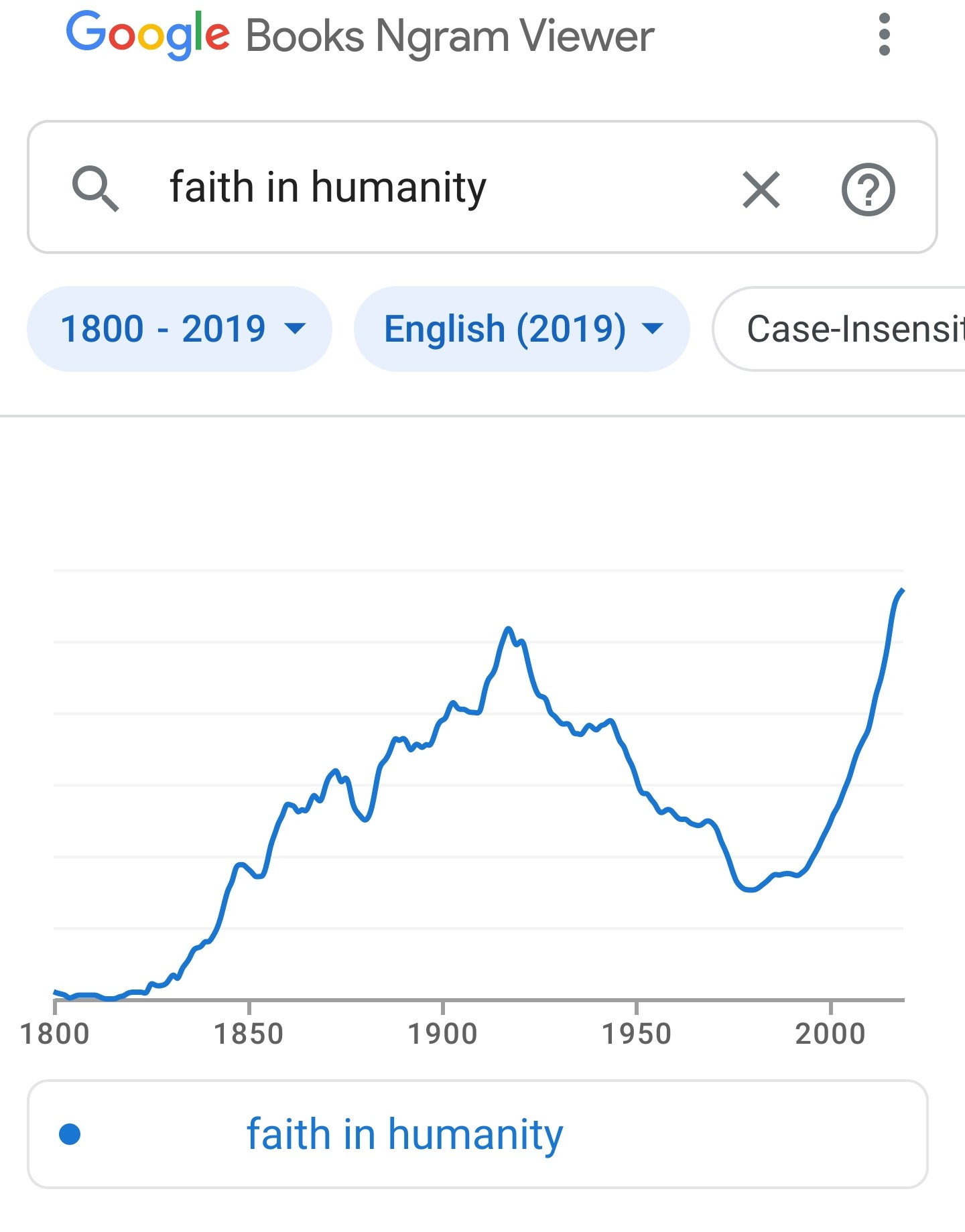
According to Google book search, the phrase goes at least back to the 1800s. It’s interesting to see that spike between 1900 and 1950. I’d bet it’s related to the horrors of WW1.
As for what it means, other posters have answered: To have faith in humanity is to believe that humans on average have an inherent desire to do the right thing.

The drag is air against the whole body of the train, so you need vacuum everywhere.
Assuming that you could build such a big vacuum there would be safety concerns. What if there’s an accident in the tube? Does everyone in the train depressurize and die? Assuming people can survive and get out of the train car, now they’re in a tube that’s 100 miles long. How can you build emergency exits in a system designed to be as airtight as possible?
Yeah, but do you want to be the person who has to fact-check every photon that hits these solar cells? I’m sorry, but a lie can radiate from the surface of a star and power your vehicle before the truth can even put its shoes on.
It’s common in communities where rigid adherence to a set of beliefs is necessary to enforce cohesion. It’s commonly used to avoid engagement with “Facts U Dislike” (haha) by terminating all meaningful discussion.
Part of a flat earth forum and you’re posting an experiment you performed that suggests the earth is round? You’re spreading FUD that should be ignored.
Posting on a crypto shitcoins discord about how this kinda looks like a scam and maybe it’s not a good investment? That’s also FUD. You’re just mad that everyone else is going to be rich.

Interesting that your days are 1-indexed. What happens on nullday?

Does that mean we no longer have to use an envvar to get Firefox as a native Wayland window?
Precisely
how can an application ship with wayland?
It can’t. The title is not clear about how Firefox will “Ship with [support for] Wayland [compositors] by default”. Previously this native support was limited to pre-release Firefox builds.
What if the DE you’re using is on x11?
Firefox continues to support X11.
I like my bag-endian architectures
You gave an example of TMZ sourcing photos from randos, but they’re likely not the target customer for this tech. If they cared about integrity they wouldn’t be reporting celebrity gossip.
For news companies posting syndicated images, then those come from a cadre of photographers who are most likely to own the newest most expensive cameras. Surely it’s not inconceivable that as this tech rolls out more, Agence-France-Presse, Getty, or AP could require all photos submitted to them to have this metadata, thus passing the benefits along to any news agency using their images.
If you’re talking about photo sources taken from everyday people, then yes: They won’t have this technology in the short term, maybe not ever. Then again, I don’t get my news from TMZ.
I think blockchain is dumb because it fails to achieve its stated goals while also harming society. I think this is a system with marginal use case and minimal licensing overhead to integrate into future cameras, so overall my take is “not dumb” and “probably useful”.
So then news orgs who care about provenance have to stop copying social media posts and treating them like well-researched journalism. Seems like a win to me.
I don’t quite get why some of those cases require universal adoption. News photos: You just need one big news company to say “we’re giving all our photographers a camera with this tech” and then it serves its purpose.
You see a headline “SHOCKING photo published by MegaNewsCorp will send you into a coma!” then you can validate that it came from a MegaNewsCorp photographer. If you trust MegaNewsCorp, then the tech has done its job. If you didn’t trust MegaNewsCorp already, then this tech changes nothing. I think there is moderate value in that, overall.
The story of this tech is getting picked up and thrown around by bad tech journalism, being game-of-telephone’d into some kind of game changer.
Plenty of open standard live and die by whether or not one big player decides to adopt them.
There’s no accounting for adoption, true. Seems like the use cases still have value though: https://c2pa.org/specifications/specifications/1.3/explainer/Explainer.html#_use_case_examples
As for licensing, the specs are released under Creative Commons, so anyone should be able to implement it.
I think that’s not the problem that this technology is intended to solve.
It’s not a “Is this picture copied from someone else?” technology. It’s a “Did a human take this picture, and did anyone modify it?” technology.
Eg: Photographer Bob takes a picture of Famous Fiona driving her camaro and posts it online with this metadata. Attacker Andy uses photo editing tools to make it look like Fiona just ran over a child. Maybe his skills are so good that the edits are undetectable.
Andy has two choices: Strip the metadata, or keep it.
If Andy keeps the metadata, anyone looking at his image can see that it was originally taken by Bob, and that Fiona never ran over a child.
If Andy strips the metadata (and if this technology is widely accessible and accepted by social media, news sites, and everyday people) then anyone looking at the image can say “You can’t prove this image was actually taken. Without further evidence I must assume that it’s faked”.
I think spinning this as a tool to fight AI is just clickbait because AI is hot in the news. It’s about provenance and limiting misinformation.
I use Fedora Sericea, another Silverblue spin, on my laptop. It wasn’t hard to install rEFInd, and it coexists just fine with GRUB in my experience. rEFInd detects that grub is there and shows it as an option, like any other bootable media.
The rEFInd documentation at https://www.rodsbooks.com/refind is extensive, but the summary of how to install is
refind-install script. If needs to be run as root.That was it for me, but the full installation steps are available at https://www.rodsbooks.com/refind/installing.html if you run into trouble.
The next time I rebooted, rEFInd popped up and I was back in Fedora with no problem.
rEFInd can auto-detect bootable devices, and you can select them during startup. You need to install it to the efi partition as your boot manager.
With a simple config edit and file copy operation, I put a memtest86 efi image on my boot partition, and it shows up as an option for every boot. It’s nice to know I won’t have to fumble around with USB drives if I need to test my RAM in the future.
I’ll believe that it’s a contender against existing quartz movements when they lay out the production costs for their design. You can’t consign discrete ticks to the dustbin of history until you can compete with a $3 SpongeBob watch from Malaysia.


$1000 that when someone sails up to their compound with a boat full of guns and grenades that they beg daddy USA for naval support.